A scanner drops in a blank page between every section. A cover memo goes out to the whole company when only three people needed it. A 40-page policy document has one outdated clause on a single page, and everything around it is still current. In every one of these situations, the document itself is basically fine — you just need one or two pages gone, and everything else left exactly where it was.
That's a narrower job than it sounds, and it's easy to reach for the wrong tool trying to do it. This guide covers exactly how to remove pages from a PDF, how the deletion syntax works, where people commonly trip up, and how the tool differs from three others that get reached for in the same moment.
What "Remove Pages" Actually Does
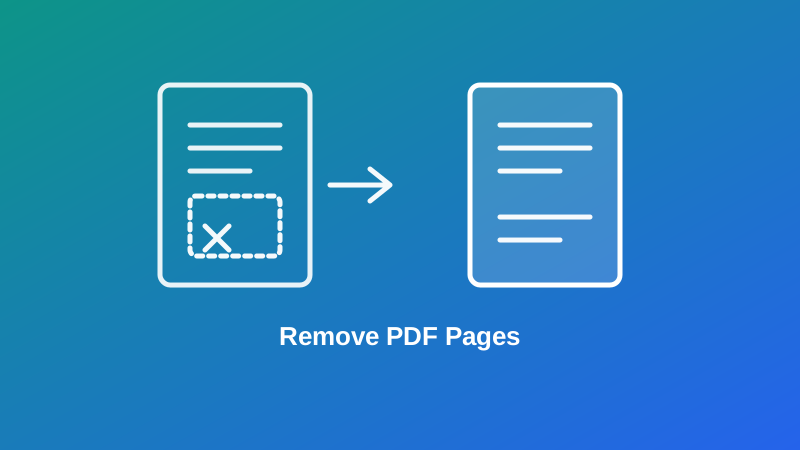
Removing pages deletes the specific pages you list and keeps everything else, in its original order, inside the same document. You're not building a new file from a shortlist of keepers — you're telling the tool which pages to throw out, and it hands back the rest, untouched.
That's the opposite of a few other page-level operations, and the difference matters more than it seems at first glance:
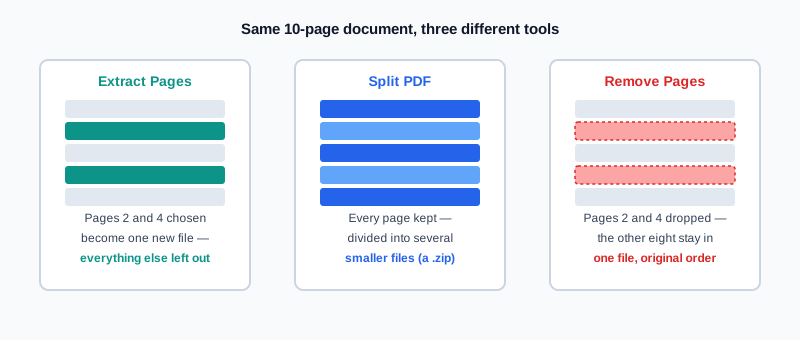
- Removing keeps everything except the pages you list, in one file.
- Extracting keeps only the pages you list, discarding everything else.
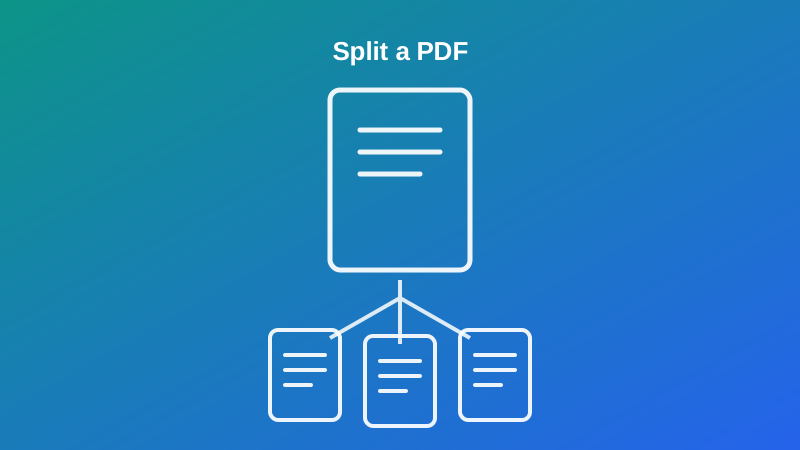
- Splitting keeps every page, just divided across several smaller files.
A quick way to decide which one you actually need: count which pile is smaller — the pages you want gone, or the pages you want to keep. If the pages you don't want are a small minority of the document, removal gets you there in fewer steps than picking out everything you do want to keep.
How to Remove Pages from a PDF, Step by Step
Step 1: Open the Remove Pages Tool
Go to My PDF's Remove Pages tool. It runs directly in your browser — no account, no software to install, and nothing to configure before you start.
Step 2: Upload Your PDF
Drag your file into the upload area, or click to browse and select it. Files up to 50 MB are accepted, with no separate cap on how many pages the document contains.
Step 3: Type in the Pages You Want Gone
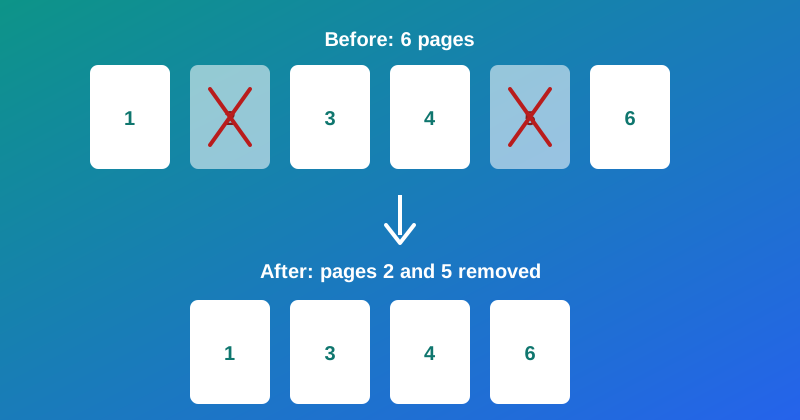
Enter the page numbers you want deleted in the Pages to remove field. A single number, a comma-separated list, a range, or any mix of both all work — 2,4 deletes pages 2 and 4 and keeps every other page exactly where it was.
Step 4: Click "Remove Pages" and Download
The tool rebuilds the document in a few seconds, minus the pages you specified. It downloads as a single PDF, with the remaining pages in their original order. Your uploaded file is removed from the server shortly afterward.
Understanding the Pages-to-Remove Syntax
The input format is the same simple syntax used across My PDF's page tools, so if you've used Extract Pages or Split PDF before, this will look familiar:
- A single number like
12deletes just that one page. - A comma separates individual pages:
2,5,9deletes exactly those three pages. - A hyphen defines a continuous range:
10-15deletes pages 10 through 15 inclusive — six pages, not five. - Combine them freely:
1,6-8,20is a perfectly valid request, and deletes five pages total.
Here's the detail that's genuinely worth knowing and rarely gets mentioned: unlike Extract Pages — where the order you type pages in determines the order they come out — Remove Pages always returns the surviving pages in their original ascending order, no matter what order you typed the pages to delete in. Typing 9,2,5 removes the same three pages as 2,5,9; the tool doesn't reorder anything, it simply figures out what's left and keeps that sequence exactly as it was. If you need to change the order of the pages that remain, that's a separate step, handled by Organize Pages.
Practical Examples
Deleting a blank page a scanner inserted. A document feeder occasionally drops in a blank separator page between sections of a batch scan. If that blank page is number 7 in an otherwise clean 20-page file, type 7, remove it, and the rest of the document closes up around the gap automatically — no renumbering to do by hand.
Removing a cover memo before forwarding a report. An internal 15-page report has a one-page cover memo (page 1) meant only for the internal team, and pages 2 through 15 need to go to an external partner untouched. Type 1, remove it, and send the result — the remaining 14 pages keep their original content and order.
Cutting an outdated clause from a policy document. A 30-page vendor agreement has one page (page 22) that references a superseded rate schedule, and a replacement page has already been inserted elsewhere in the workflow. Type 22, remove the stale page, and the rest of the agreement is left exactly as it was, front matter and all.
Remove vs. Extract vs. Split vs. Organize
All four of these operate on the same territory — "something about this document's pages needs to change" — but each answers a different question:
| Tool | What it does | Use it when |
|---|---|---|
| Remove Pages | Deletes the pages you list, keeps the rest | A small minority of pages need to go |
| Extract Pages | Keeps only the pages you list, in one new file | You need a small, specific subset — the rest can be discarded |
| Split PDF | Breaks the whole document into multiple files | Every page (or group of pages) needs to become its own file |
| Organize Pages | Changes the order pages appear in | The content is right, but the sequence isn't |
A fast way to check you've picked correctly: say out loud what you want. "I need everything except page 6" points straight to Remove. "I only need pages 4 and 9" points to Extract instead. If what you're really describing is "these pages are all here, just in the wrong order," neither tool is right — that's Organize Pages.
Common Mistakes When Removing PDF Pages
Confusing removal with extraction. These are mirror-image operations, and it's an easy mix-up under time pressure. If you list the pages you want to keep in the Remove Pages tool by mistake, you'll delete the wrong 95% of your document. Read the field label once before typing.
Removing pages by their printed number instead of their actual position. A scanned booklet might display "Page 1" on what's actually the fourth page of the PDF file, after a cover and a table of contents. Always count from your PDF viewer's own page counter, not any number printed on the page itself.
Miscounting a hyphenated range. 10-15 deletes six pages, not five — the range includes both endpoints. Open the result afterward and confirm the page count matches what you expected before sending it anywhere.
Trying to remove every page. A document needs at least one page left standing, so a request that would delete the entire file — say, 1-20 on a 20-page document — is rejected rather than silently producing an empty file. If you genuinely need nothing from a document, deleting the file itself is simpler than removing every page from it.
Forgetting that a password-protected file needs unlocking first. An encrypted PDF can't have pages removed until the password comes off. Run it through Unlock PDF with the current password first, then remove pages from the unlocked copy.
Assuming removal deletes content within a page. This tool removes whole pages, not specific text, images, or sections on a page. If sensitive content shares a page with material you need to keep, deleting the whole page throws out the good part too — that situation calls for editing the page's content directly, not removing it.
Tips & Best Practices
- Check the page count in a viewer first, especially with a scanned document where printed numbering and actual PDF position can drift apart by a page or two.
- Use a range for consecutive deletions —
12-18is faster and less error-prone than typing seven separate numbers. - Open the result before forwarding it, particularly after a range-based deletion, to confirm the boundaries landed exactly where you expected.
- Unlock protected files before removing pages from them. Encryption has to come off first, using the file's current password.
- Remove before you merge, not after, when a blank or unwanted page belongs to just one of several files you're about to combine — it's one less thing to clean up in the final, merged document.
- Keep a copy of the original until you've confirmed the trimmed file is correct, particularly for anything you can't easily re-scan or regenerate.
Key Takeaways
- Removing keeps everything except the pages you list — the opposite of extracting, which keeps only the pages you list.
- The syntax accepts single pages, comma-separated lists, hyphenated ranges, or any mix —
1,6-8,20is a valid request. - Unlike Extract Pages, the pages that remain always come back in their original ascending order, regardless of the order you typed the pages to delete.
- Always count pages from your PDF viewer's own counter, not a number printed on the page, especially with scanned documents that include front matter.
- An encrypted source file needs to be unlocked before any pages can be removed from it.
- The tool won't let you delete every page in a document — at least one has to remain.
Related Reading
For the full set of page-level tools working together — splitting, extracting, removing and reordering — see the complete guide to organizing PDF pages. If what you actually need is the opposite operation, how to extract pages from a PDF covers pulling a specific subset out into its own file. For more guides like this one, browse the full blog or the complete tools directory. For background on how pages are structured inside the format itself, see Wikipedia's entry on PDF.
Have a page or two that needs to disappear right now? Open the Remove Pages tool and have your cleaned-up file ready in seconds.
Comments
Comments aren't open on the blog yet. In the meantime, share this article using the buttons above, or reach us directly at contact@mypdf.tech.